
Once you have completed the product specification sheet in Step 1, the next step is to find suppliers that can meet your requirements.
Finding suppliers in China is not difficult. Finding the right one takes more work.
Price is only one factor. You also need to know who you are dealing with, whether the supplier can make your product, and whether the information they provide can be verified.
In this step, we will cover where to find Chinese suppliers, how to send an RFQ, how to check supplier backgrounds, and how to compare your options before making a shortlist.
Where to Find Suppliers in China
There is no single best place to find Chinese suppliers. The right channel depends on what you are sourcing, your order size, and how much local support you need.
1. Alibaba
For many international buyers, Alibaba is one of the easiest places to start.
You can search for products and suppliers directly or contact potential suppliers for quotations.
Supplier profiles also provide information that can help with your first round of screening. For example, Alibaba’s Verified Supplier program uses third-party onsite verification and provides assessment reports that buyers can view.
Still, a platform badge should only be used as a screening tool. It does not replace your own supplier checks.
2. 1688
1688 is one of the main platforms we use when researching products and suppliers in China.
Unlike Alibaba, 1688 mainly serves China’s domestic wholesale market. Alibaba Group describes it as China’s leading integrated domestic wholesale marketplace.
You can often find more local suppliers and products there, including sellers that do little or no marketing to overseas buyers.
The downside is that many sellers mainly work with Chinese buyers. Communication, payment, export experience, and international shipping may therefore require more effort.
If you speak Chinese or have someone locally who can help, 1688 is well worth checking.
But a lower price does not automatically mean a better supplier. You still need to check whether the company can meet your product and export requirements.
3. Canton Fair
If you prefer meeting suppliers in person, the Canton Fair is another useful sourcing channel.
You can see products, ask questions, collect quotations, and compare several suppliers within a short period of time.
It is also useful to do some research before visiting. The official Canton Fair website allows buyers to search suppliers and products and publish sourcing requests for supplier matching.
Fair dates and product phases change, so check the official website when planning your visit.
4. Work With a Sourcing Agent
A sourcing agent can be useful if you do not speak Chinese, are unfamiliar with the local market, or simply do not have time to research and contact many suppliers yourself.
A local sourcing team can help you search domestic platforms, communicate with suppliers, collect quotations, and narrow down your options.
For example, MySourcify is based in Yiwu and helps overseas buyers with supplier sourcing and purchasing coordination.
This can be especially useful when a good supplier has little international presence or mainly sells through domestic channels such as 1688.
5. Chinagoods
If you are sourcing from Yiwu, you may also come across Chinagoods.
Chinagoods is the official online platform of the Yiwu market operator, Zhejiang China Commodities City Group. Buyers can browse products and suppliers linked to physical booths in the Yiwu markets.
In our day-to-day sourcing work in Yiwu, however, we tend to use platforms such as 1688 more often for general supplier searches.
Chinagoods works better as a supplementary tool, especially if you want to research the Yiwu market before visiting in person.
6. Other Ways to Research Suppliers
Not every sourcing channel needs a full section. The following options can also be useful depending on your product and sourcing goals.
| Method | Examples | Best for |
| Other B2B platforms | Made-in-China | Finding more export-oriented suppliers |
| Search engines | Google, Baidu | Finding company websites and cross-checking supplier information |
| Chinese marketplaces | Taobao, Pinduoduo | Product and price research |
| Small-order marketplaces | AliExpress, DHgate | Testing products or buying small quantities |
| Wholesale markets | Yiwu Futian Market, Guangzhou wholesale markets, Chenghai Toy Market | Offline sourcing and face-to-face comparison |
| Industry trade shows | Product-specific exhibitions | Finding suppliers in a particular industry |
Send RFQs to Potential Suppliers

Once you have found several potential suppliers, contact them with the same basic requirements and ask for quotations.
This is where the product specification sheet from Step 1 becomes useful.
Instead of sending a vague message such as “How much is this?”, give suppliers enough information to quote the same product.
- Your RFQ can include:
- product specifications;
- materials, dimensions, colors, and customization requirements;
- estimated order quantity;
- MOQ;
- packaging requirements;
- unit price;
- sample availability and cost;
- production lead time;
- required certificates;
- quotation terms;
- payment terms; and
- any extra tooling or setup costs.
Try to send the same requirements to each supplier.
If one supplier quotes 1,000 units with custom packaging while another quotes 5,000 units without packaging, the two prices are not directly comparable.
1. How to Write a Supplier Inquiry
Your first message does not need to be long. It just needs to be clear.
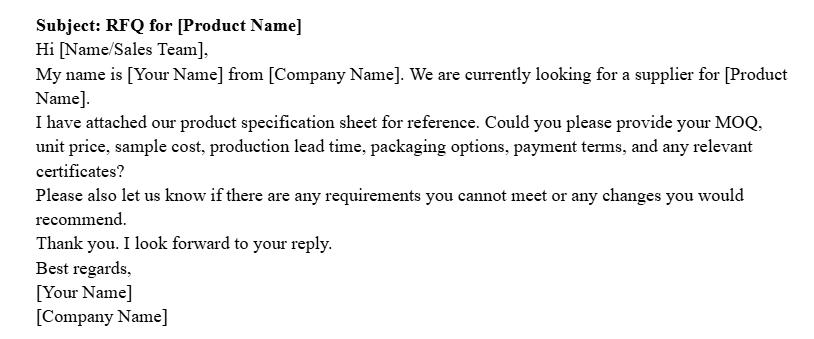
If you found the supplier through a sourcing platform, you can also communicate through its messaging system.
2. How to Get Better Responses
Avoid sending a message that only says: “How much?”
Without product details, quantity, packaging, or customization requirements, the supplier cannot prepare an accurate quotation.
Briefly introduce your company and explain what you are sourcing. There is no need to exaggerate your order volume.
If a promising supplier does not reply, send a short and polite follow-up.
For complicated or highly customized products, a call or video meeting can also help clarify technical questions.
3. Use the Replies for Initial Screening
When the quotations come back, do not look only at the unit price.
Check whether each supplier quoted the correct product specification and quantity.
Also compare the MOQ, lead time, packaging, tooling costs, customization costs, certificates, and quotation terms.
Communication matters too.
A supplier does not need perfect English. What matters is whether they understand your questions, give clear answers, and tell you honestly when something cannot be done.
Remove suppliers that clearly do not meet your requirements. Then check the remaining companies in more detail.
How to Verify a Chinese Supplier

Before working with a supplier, take some time to check who you are actually dealing with.
1. Check the Business License
Ask the supplier for a copy of its Chinese business license.
Check the:
- official Chinese company name;
- Unified Social Credit Code;
- registered address;
- establishment date;
- company type; and
- business scope.
The Chinese registered company name and Unified Social Credit Code are more useful for verification than an English company name, which may be translated in different ways.
2. Search the Company on the Official Chinese Database
Use China’s National Enterprise Credit Information Publicity System to cross-check the supplier’s company information.
The system requires real-name registration and login. This can make it less convenient for some overseas buyers.
If you can access it, compare the public record with the business license and the information the supplier has given you.
Look for obvious differences in the company name, address, business scope, or registration status.
A normal company record does not guarantee that the supplier is reliable, but it helps confirm that you are dealing with a registered business.
3. Check Whether It Is Really a Manufacturer
Do not decide whether a supplier is a manufacturer based only on its company name or address.
Ask questions such as:
- Where is your factory?
- Which production processes are done in-house?
- Which processes are outsourced?
- What products do you mainly manufacture?
You can also ask for factory photos, videos, or a third-party audit report.
A trading company is not automatically a bad choice. You simply need to know who you are working with and whether they can meet your requirements.
4. Check Important Certificates
If your product requires certificates or compliance documents, do not simply accept a PDF or screenshot.
Check whether the company name and product information match your order, whether the document is still valid, and who issued it.
If the certificate is important for selling the product in your target market, verify it with the issuing organization or the relevant official database.
Compare and Shortlist Suppliers
Once the background checks are done, compare the remaining suppliers using the same criteria.
A simple table can help:
| Criteria | Supplier A | Supplier B | Supplier C |
|---|---|---|---|
| Product fit | |||
| Unit price | |||
| MOQ | |||
| Lead time | |||
| Customization | |||
| Communication | |||
| Company verification | |||
| Relevant certificates | |||
| Manufacturing capability | |||
| Sample availability | |||
| Payment terms |
Supplier Red Flags to Watch For

One warning sign does not always mean a supplier is fraudulent. But if something does not make sense, check it before moving forward.
1. Company Information Does Not Match
Be careful if the company name, business license, address, quotation, or other documents contain unexplained differences.
Small differences in an English company name can happen, but the legal Chinese company information should be consistent.
2. The Price Is Unusually Low
A much lower price may look attractive, but first check what is included. The supplier may be quoting a different material, quantity, packaging option, or specification.
Compare quotations on the same basis before choosing the cheapest one.
3. The Supplier Avoids Specific Questions
A supplier does not need perfect English. What matters is whether they understand your questions and give clear answers.
If you repeatedly ask where a product is made or which processes are outsourced and only receive vague replies, more checking may be needed.
4. Certificates Cannot Be Verified
Be careful if a supplier only provides a certificate logo, blurry screenshot, expired document, or certificate that does not match the company or product.
Ask for the full document and verify it when necessary.
5. Manufacturing Claims Lack Evidence
If a supplier claims to own a factory but cannot provide basic information about its location, production process, equipment, or capacity, investigate further.
Saying “we are a factory” is not evidence by itself.
6. Payment Details Suddenly Change
Pay attention if the supplier suddenly asks you to send money to a different company or bank account.
There may be a reasonable explanation, but confirm the change before making any payment.
Real Case Study: An Importing Fraud Case
Supplier checks can reduce risk, but problems can still happen when important warning signs are missed.
In this case study, we share a real experience from one of our customers and what importers can learn from it.
The key lesson is simple: do not rely on a single sign that a supplier looks legitimate.
Check the company information, payment details, and any unexpected changes before sending money.
Final Supplier Selection Checklist
Before moving on to sample development, make sure you have:
- checked the supplier’s legal company information;
- compared it with public records;
- confirmed whether you are dealing with a manufacturer, trading company, or both;
- checked whether the supplier can meet your product requirements;
- verified important certificates where necessary;
- compared quotations on the same basis;
- checked MOQ and lead time;
- reviewed the supplier’s communication; and
- investigated any unresolved warning signs.
You do not need to find a “perfect” supplier at this stage.
You need a shortlist of suppliers that are worth testing further.
Conclusion
Supplier research should not end when you find a good price.
Start with the right sourcing channels, send clear RFQs, check supplier information, and compare your options carefully.
A little more work at this stage can help you avoid much bigger problems later.
Once you have a few promising suppliers on your shortlist, move on to Step 3: Pre-Production Sample Development.
Hope you find this article helpful for your importing business. Let us know if we have further to improve! Please leave your sweet suggestions on comments. Thanks for helping us to get better!


6 Responses
The tips to prevent from help me learn a lot and give me some experience.thx
My name is Humphrey Chibuike from Nigeria, I’m into whole sales and retail sales of different kinds of mobile phones and phones accessories like LCD, batteries etc.
I want to go into importation of the products mentioned above, from China but don’t know much on importation, especially, the risk involved (scam).
But with the ur video and teaching, I have leant a lot. Thanks.
thank you, our agent will contact you soon
I have various suppliers around China – i wish to consolidate the orders so i only import one shipment into the UK
thank you our agent will contact now